Automating COICOP Coding for Household Budget Surveys
Groupe de veille en analyse textuelle
2026-06-30
1 1. Context
1.1 Some context elements
Context
COICOP : Classification of Individual Consumption by Purpose
- Hierarchical classification : on 5 levels → we code at level 4
- Assigning a code requires understanding both the product and its purpose
| Level | Example |
|---|---|
| 1 - Division | 01 - Food |
| 4 - Sub-class | 01.1.1.1 - Rice |
Household Budget Survey (HBS) : new wave in 2026
Goal: understand households expenditure (consumption basket)
~70,000 distinct free-text labels to code into COICOP
New collection modes: smartphone, receipts, paper
COICOP updated since 2017 → limited reuse of past labels
Annotation team: 7 people → 1
Deadline: 6 months to build a production-ready pipeline
1.2 Key challenges
Context
Classification
- ~900 granular COICOP classes (all 5 levels)
Labels
- Heterogeneous textual inputs across sources
- Generic, ambiguous, or uninformative (“various food”, “article”)
- Same string can map to different codes depending on context
Annotation
- Few annotated labels available (fewer human resources)
- Limited and unevenly distributed labelled data across COICOP divisions
Tools
- No GPU available on production servers
2 2. The Coding Methods
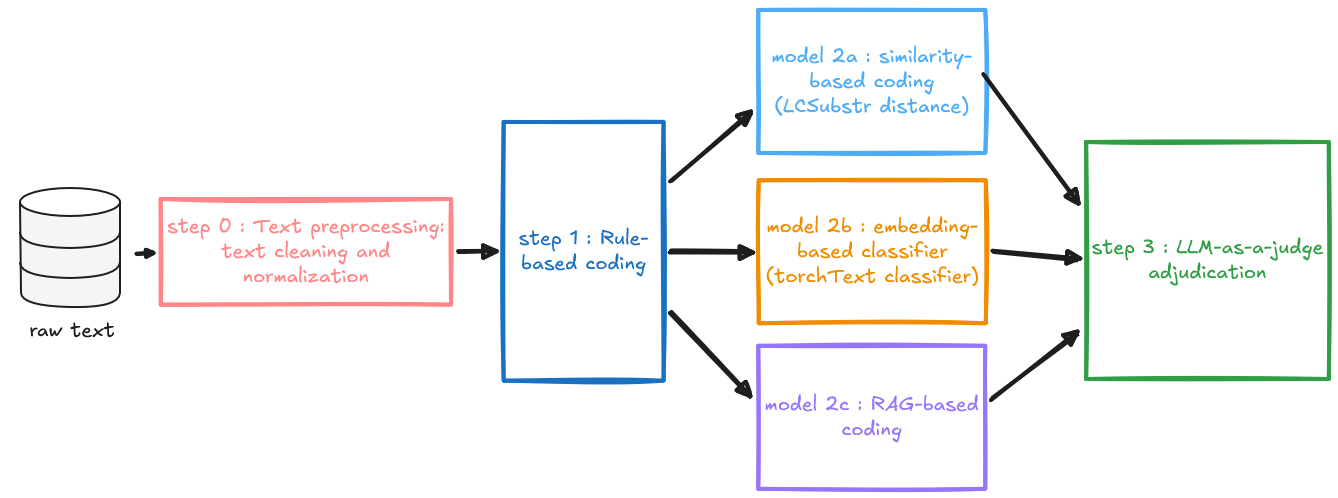
2.1 Pipeline overview
The Coding Methods
2.2 Method 1 - LCSubstr: leveraging historical annotations
The Coding Methods
Principle
- Compares each label against a suggester: a curated list of reliably coded labels with their validated COICOP code
- Returns the best match and its similarity score
Example - Query: "baguette" (bread)
| Suggester candidate | Code | LCSubstr distance |
|---|---|---|
| baguette | 01.1.1.1 |
0.0 |
| baguette en bois | 05.5.2 |
0.5 |
→ Best match (lowest distance): 01.1.1.1
Output: top-1 candidate code + LCSubstr distance
2.3 Method 2 - TTC: embedding-based classifier
The Coding Methods
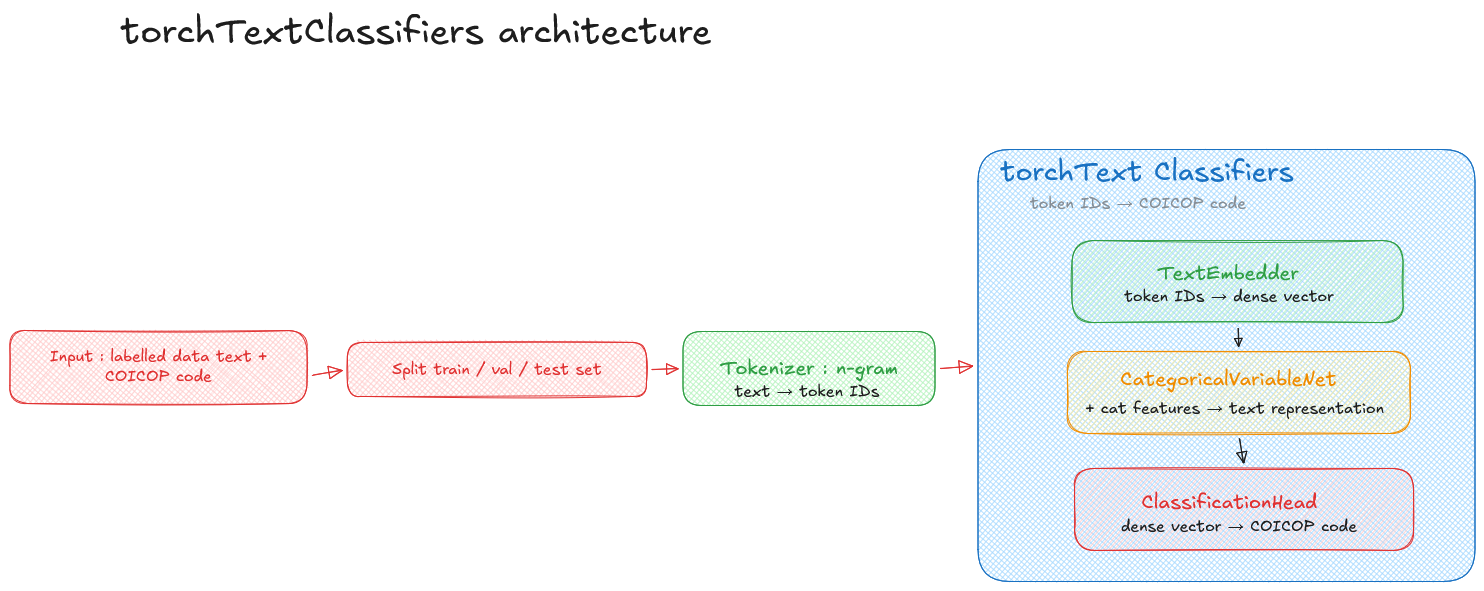
torchText Classifiers : Architecture
- Inspired by fastText
- Character n-gram tokenizer (3–6 grams) + 128-dim embedding
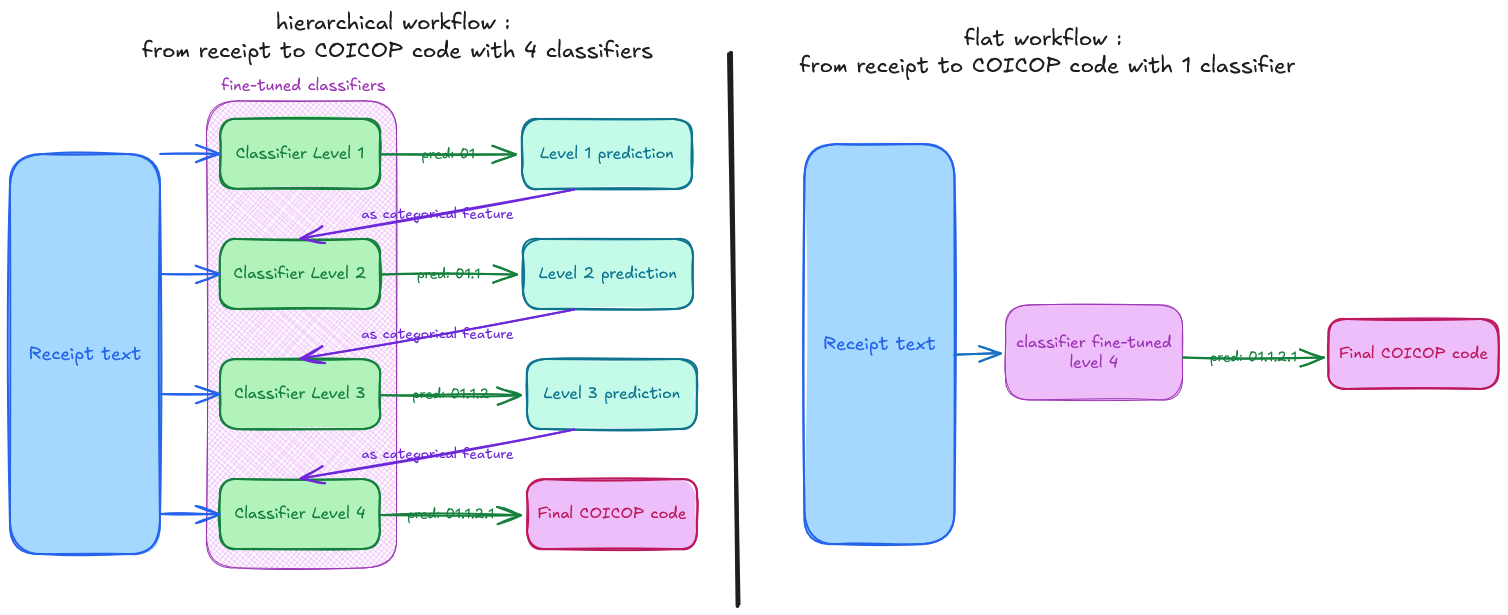
- Flat variant: direct level 4 COICOP prediction
- Hierarchical variant: cascade of 4 classifiers, one per COICOP level
Training data
- Pre-trained on ~3M scanner data labels (point-of-sale data), completed with LLM-generated synthetic labels for underrepresented COICOP classes
- Fine-tuned on ~10k HBS annotations
Output: top-k predictions + confidence scores + word attributions
2.4 Method 3 - RAG: semantic retrieval
The Coding Methods
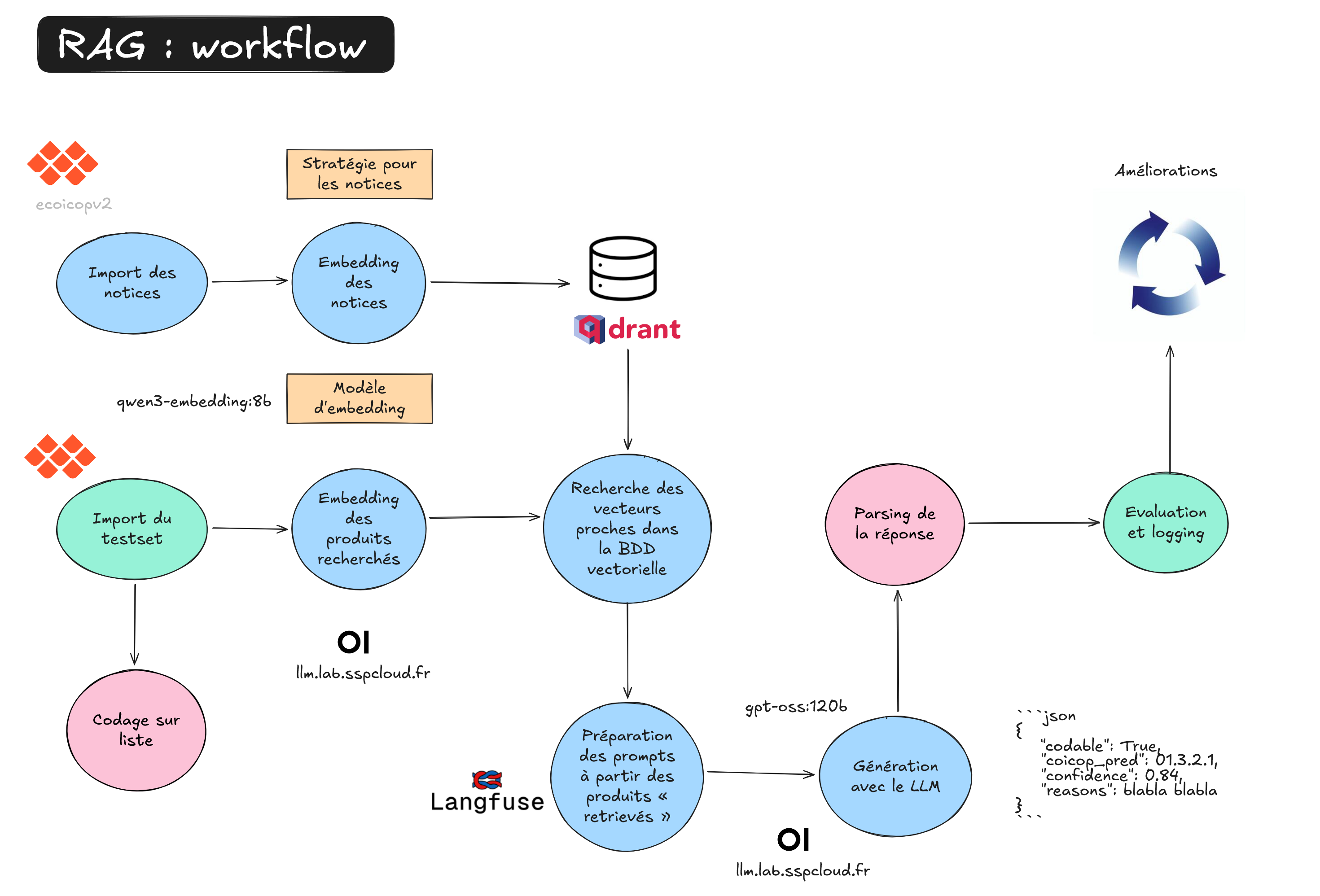
Principle
- Embed the product label → retrieve the top-10 most semantically similar COICOP codes from a Qdrant vector DB
- Inject candidates + their official COICOP notices into an LLM prompt → generate the predicted code (structured JSON)
Model choices (deployed on vLLM)
- Embedding: Qwen3-Embedding-8B (vector size 4096d)
- Generation: Gemma4-26B-MoE (temperature 0.1), structured JSON output with reflection elements
Output: predicted COICOP code (JSON) + LLM self-confidence score
2.5 Methods comparison
The Coding Methods
| LCSubstr | TTC | RAG | |
|---|---|---|---|
| Annotation burden | Low | High | None |
| Process | No LLM, no GPU | GPU training / no LLM at inference | LLM + vector DB at inference |
| Speed | Fast (parallelised C) | Slow training / Fast at inference | Slower (LLM generation) |
| Quality signal | LCSubstr distance (0–1) | Calibrated confidence score | LLM self-reported confidence |
| Explainability | Common substring | Word attributions | LLM self-reporting |
| Accuracy L1 | 67.5% | 87.6% | 82.7% |
| Accuracy L4 | 47.1% | 81.1% | 65.5% |
3 3. LLM-as-Judge
3.1 Arbitrating between methods
LLM-as-Judge
The arbitration step
- Receives predictions + scores from LCS, TTC, RAG
- The LLM sees: the product label, shop context, the three candidates, and a filtered COICOP nomenclature (codes + labels)
- Selects the most appropriate code and returns a confidence score (1–5)
Why LLM rather than majority vote?
A vote counts voices but the LLM weights quality signals (confidence, distance) and uses the full purchase context to resolve what no method could distinguish alone.
Two cost-saving shortcuts
- Consensus short-circuit : if all three methods agree and TTC confidence ≥ 0.90 → no LLM call, prediction accepted directly
- Classification filtering : only the relevant COICOP sections are injected → 4–10× fewer tokens
4 4. Results
4.1 Results
Results
| Pipeline coding stage | Coverage |
|---|---|
| Step 1 - Regex | |
| Regex pattern | 8% |
| Manual review flagged | 1% |
| Step 2 - Three methods | |
| Consensus shortcut (no LLM call) | 7% |
| Step 3 - LLM-as-Judge | |
| LLM-as-Judge arbitration | 84% |
| ↳ of which: flagged for expert review | 3.5% |
Accuracy (~7,350 annotated labels)
- Human baseline: ~90% at L5 (with internet access)
- Pipeline (no external lookup):
- L1: 90.0% → consumption baskets (best single method → TTC: 87.6%)
- L4: 82.6% → HBS team (best single method → TTC: 81.1%)
- L5: 79.4% → Eurostat (only the pipeline produces it)
Accuracy likely underestimated: ~10% known error rate in manual annotations (domain expert estimate).
4.2 Accuracy by division
Results
Division-level (L1) accuracy over the ~7,350 annotated test labels. Overall the pipeline lands in the correct COICOP division 90.0% of the time, but accuracy and coverage vary widely between divisions.
| Division (level 1) | n | Acc. L1 |
|---|---|---|
| 01 Food & non-alcoholic beverages | 3,591 | 97.9% |
| 02 Alcoholic bev., tobacco, narcotics | 130 | 94.6% |
| 03 Clothing & footwear | 241 | 87.1% |
| 04 Housing, utilities & fuels | 219 | 72.1% |
| 05 Furnishings & household equipment | 372 | 86.6% |
| 06 Health | 203 | 88.2% |
| 07 Transport | 422 | 94.1% |
| 08 Information & communication | 127 | 94.5% |
| Division (level 1) | n | Acc. L1 |
|---|---|---|
| 09 Recreation, sport & culture | 669 | 89.1% |
| 10 Education | 23 | 69.6% |
| 11 Restaurants & accommodation | 492 | 78.9% |
| 12 Insurance & financial services | 124 | 89.5% |
| 13 Personal care & misc. services | 301 | 90.7% |
| 98 Ambiguous / non-codable labels* | 229 | 23.6% |
| 99 Non-consumption expenditure* | 207 | 75.4% |
| Overall | 7,350 | 90.0% |
5 5. MLOps
5.1 MLOps: the experimentation stack
MLOps
SSPCloud : INSEE’s open data science platform, built on Onyxia, running on Kubernetes. This platform is not a production one, used for experimentation but the pipeline is designed to be production-ready.
Argo Workflows sequences the 9 pipeline steps, running the three methods in parallel, then feeding results into the LLM-as-Judge
Each step reads/writes Parquet files on S3
LLMs are served via vLLM and exposed through an internal LLM platform providing an OpenAI-compatible API, connected to SSPCloud.


| Component | Role |
|---|---|
| Argo Workflows | jobs orchestration |
| vLLM | LLM inference & embeddings |
| Qdrant | Vector database |
| Langfuse | Prompt versioning |
| MLflow | Experiment tracking |
6 6. Conclusion
6.1 Limits & Improvements
Conclusion
Current limits
- Strong dependency on the quantity and quality of annotated data:
- Collecting 3M annotated labels for TTC training : high effort, hard to scale
- Accuracy underestimated : ~10% error rate in manual annotations inflates apparent errors
- Sparse coverage for some COICOP divisions (level 1)
- Poor reliability of confidence indicators to target manual review effectively
- Deployment challenges (GPU requirements)
Improvements
- Add additional inputs from 2017 HBS labels
- Improve the LCS suggester with richer (product, code) pair context
- Improve the TTC model with a receipt-specific tokenizer
- Log all RAG traces in Langfuse, not just prompt versioning
6.2 Conclusion
Conclusion
A hybrid, production-ready pipeline
- Rule-based pre-filter handles high-confidence, easy cases at zero ML cost
- Three different coding methods : LCS, TTC, RAG
- LLM-as-Judge arbitrates intelligently between them
- Fully open-source MLOps on SSPCloud
The key message
- Product and activity coding is a recurring bottleneck across official statistics.
- Our method offers a viable path forward for any survey requiring classification.
- TTC can be retrained for any classification task or language, the main requirement is an annotated training dataset.
- Cédric COURALET
- Laura GAIMARD
- Julien PRAMIL
- Directorate of statistical methodology
- Insee — France
- cedric.couralet@insee.fr
- laura.gaimard@insee.fr
- julien.pramil@insee.fr


