class MLFlowPyTorchWrapper(mlflow.pyfunc.PythonModel):
  def __init__()
    ...

  def predict(self, model_input: list[SingleForm], params=None) -> list[PredictionResponse]:
    query = self.preprocess_inputs(
            inputs=model_input,
        )

    # Preprocess inputs
    text = query[self.text_feature].values
    categorical_variables = query[self.categorical_features].values

    ...

    all_scores = []
    for batch_idx, batch in enumerate(dataloader):
        with torch.no_grad():
            scores = self.module(batch).detach()
            all_scores.append(scores)
    all_scores = torch.cat(all_scores)
    probs = torch.nn.functional.softmax(all_scores, dim=1)

    ...

    responses = []
    for i in range(len(predictions[0])):
        response = process_response(predictions, i, nb_echos_max, prob_min, self.libs)
        responses.append(response)

return responsestorchTextClassifiers: A unified framework for text classification in PyTorch
9 December 2025
Link to the presentation:
In the chat!
👨🔬 Who are we ?
Two data scientists from the innovation team at Insee:
- Cédric Couralet
- Previously software developer, architect, devops/security engineer… at Insee
- Currently helping real data scientists bridge the gap between experimentation and production (How to talk to IT)
- Open Source advocate
👨🔬 Who are we ?
Two data scientists from the innovation team at Insee:
- Meilame Tayebjee
- Graduated 2024
- Currently pursuing a part-time PhD in AI applied to health econometrics
- At Insee:
- working on deep learning for text classification, computer vision with remote sensing data, MLOps practices
- exploring explainability, calibration, LLMs, RAGs & agentic workflows
💡 What will we talk about ?
- MLOps pipeline for text classification at Insee
- The constraint that pushed us to open-source a PyTorch package: why and how
1️⃣ Context
Use case (1/2)
- NACE automatic coding (code APE) for the national business registry (Sirene)
- Given an activity description and some additional info, assign one of the ~750 NACE labels
- Sparse-label extreme multi-class text classification task with categorical variables
- If model is not confident, human annotators enter the loop (reprise manuelle)
- The automatic coding model reliability is highly critical
Use case (2/2)
- Lot of training data, but not necessarily reliable
- Coming from previous classification by a deterministic algorithm (Sicore) (1996-2021) and fastText (2021-2025)
- Training on GPU but non-batched (online) inference on CPU (secured offline environment)
- Special care about responsive inference time (<200 ms)
2️⃣ MLOps pipeline
The ideal MLOps pipeline…
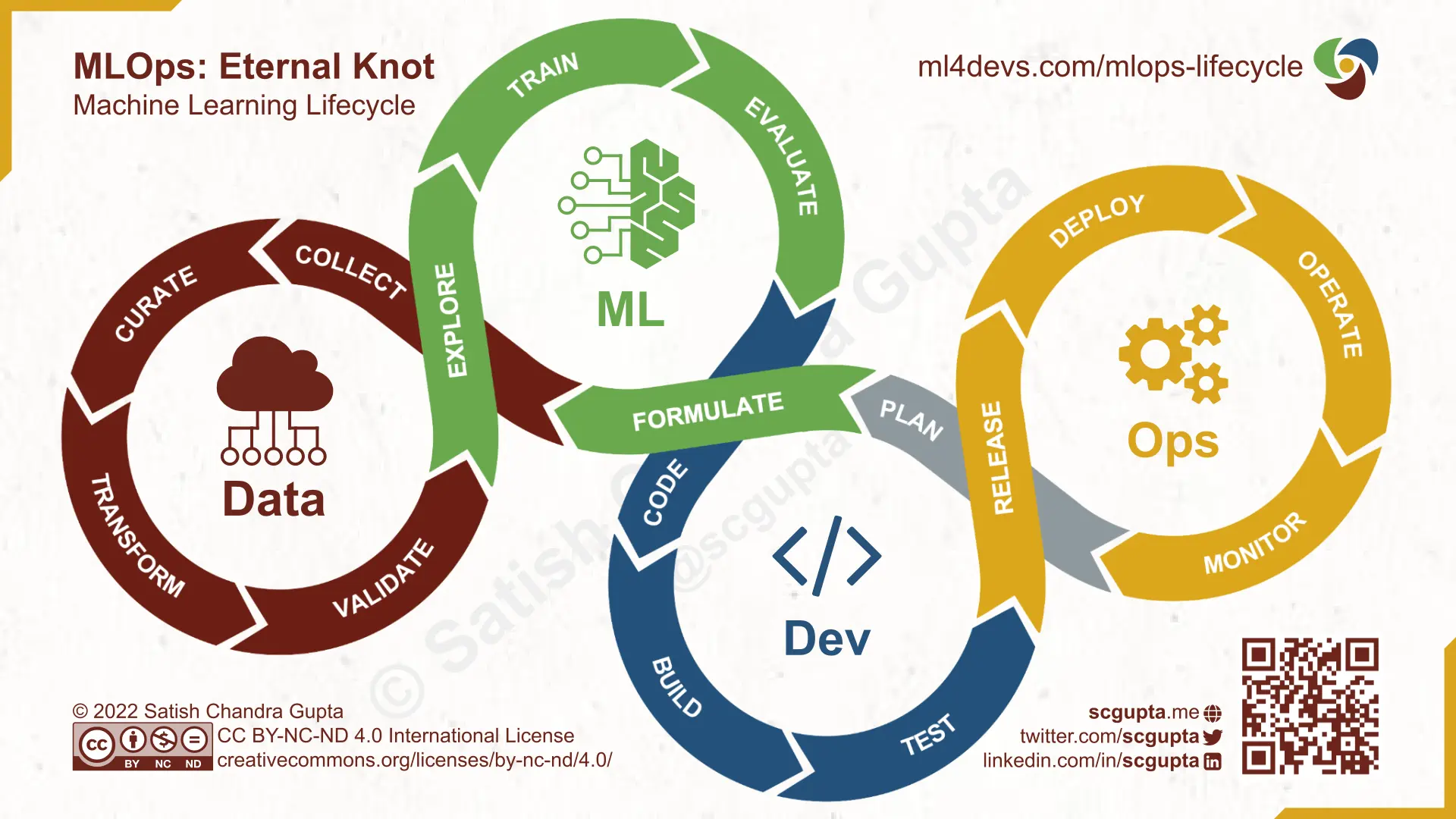
… vs ours

Extensive use of MLFLow
- MLflow used as a:
- Training monitor
- Model store and “versioner”
- Model wrapper (using pyfunc object from MLFLow)
- Models are packaged with all the metadata necessary to run inference
The wrapper
API serving
- Text classification model served through a containerized REST API:
- Simplicity for end users
- Standard query format
- Scalable
- Modular and portable
- Simple design thanks to the MLFLow wrapper
- Continuous deployment with Argo CD
@router.post("/", response_model=List[PredictionResponse])
async def predict(
    credentials: Annotated[HTTPBasicCredentials, Depends(get_credentials)],
    request: Request,
    forms: BatchForms,
    ...
    num_workers: int = 0,
    batch_size: int = 1,
):
    """
    Endpoint for predicting batches of data.

    Args:
        credentials (HTTPBasicCredentials): The credentials for authentication.
        forms (Forms): The input data in the form of Forms object.
        num_workers (int, optional): Number of CPU for multiprocessing in Dataloader. Defaults to 1.
        batch_size (int, optional): Size of a batch for batch prediction.

    For single predictions, we recommend keeping num_workers and batch_size to 1 for better performance.
    For batched predictions, consider increasing these two parameters (num_workers can range from 4 to 12, batch size can be increased up to 256) to optimize performance.

    Returns:
        list: The list of predicted responses.
    """
    input_data = forms.forms

    ...

    output = request.app.state.model.predict(input_data, params=params_dict)
    return [out.model_dump() for out in output]
API serving

API serving
async function transformToPost(description, top_k) {
  // Base URL with query parameters
  const baseUrl = `https://codification-ape2025-pytorch.lab.sspcloud.fr/predict/?nb_echos_max=${top_k}&prob_min=0.01&num_workers=0&batch_size=1`;

  // Build the request body according to the expected schema
  const body = {
    forms: [
      {
        description_activity: description
      }
    ]
  };

  // Send the POST request
  const response = await fetch(baseUrl, {
    method: "POST",
    headers: {
      "Content-Type": "application/json"
    },
    body: JSON.stringify(body)
  });

  // Parse and return the JSON response
  return response.json();
}
viewof activite = Inputs.text({
label: '',
value: 'coiffure',
width: 800
})
viewof prediction = Inputs.button("Run Prediction", {
reduce: async () => {
return await transformToPost(activite, 5);
}
})
// afficher les résultats joliment
prediction_table = {
if (!prediction || !prediction.length) {
return html``
}
// la réponse est un tableau avec un seul objet
const result = prediction[0]
const { IC, MLversion, ...codes } = result
const rows = Object.values(codes).map(({ code, libelle, probabilite }) => {
return html`
<tr>
<td>${code} – ${libelle}</td>
<td style="text-align:right;">${probabilite.toFixed(3)}</td>
</tr>
`
})
return html`
<table style="border-collapse: collapse; width: 100%;">
<caption style="margin-bottom: 0.5em;">
Confidence score : ${(+IC).toFixed(3)}
</caption>
<thead>
<tr>
<th style="text-align:left;">Description (NA2008)</th>
<th style="text-align:right;">Probability</th>
</tr>
</thead>
<tbody>
${rows}
</tbody>
</table>
`
}3️⃣ torchTextClassifiers, an open-source package to distribute PyTorch models
Beyond fastText ?
- fastText: a powerful and efficient model that has been used in production since 2021…
- … but the library repo has been archived on March 19th, 2024
This non-maintenance is highly problematic in the medium-term:
- Potential appearance of (non-fixable) bugs
- Conflicting versions of dependencies
- Modernization hindrance
PyTorch: why ? Some strategic reflections…
💡 Idea: Develop our custom PyTorch-based model to:
- adapt and customize the architecture for our specific needs (text classification with categorical variables)
- limit dependencies to external libraries and internalize maintenance for more robustness in the long-term
- access to the vibrant deep learning / NLP community to develop additional features (explainability with Captum, calibration with torch-uncertainty…)…
Packaging the architecture: why ?
- Conceptually, the model architecture has its own life
- Can be used for many other use cases
- Has its own development, versioning etc.
- This justifies to have its own repo, distinct from the train or API one
- From an MLOps point of view:
- The model is travelling between different teams and repos (train, inference, prod): we need to have a Single Source of Truth for easy deployment and versioning!
- PyPI plays the remote role
- The model is travelling between different teams and repos (train, inference, prod): we need to have a Single Source of Truth for easy deployment and versioning!
Our solution: torchTextClassifiers
- The package:
- Conceptualizes the different components of a text classification model to flexibly manipulate them
- Distributes SOTA architectures incl. self-attention layers (you can make your own small BERT!)
- Enables to easily instantiate and train those components, while proposing additional features such as explainability
- You can use any tokenizer from HuggingFace or train your own one
- Targets:
- All those who want to train their home-made - possibly small - models, customize their architectures and can’t deploy big models from HuggingFace
Positioning

Production POV
The different components

Demo
Link to the doc

https://inseefrlab.github.io/torchTextClassifiers/
4️⃣ Perspectives
MLOps
- Bridging the gap between innovation and production:
- full automation between data extraction, model training and qualification, model deployment
- observability of the model in production: logs, continuous annotation…
Roadmap for torchTextClassifiers
- Additional features:
- include more architectures: gated attention, text-label cross-attention
- controlling uncertainty: calibration & conformal prediction
- quantization
- push / pull from HF
- Always fully open-sourced!
Thank you for your attention.
Find here all of our repos on the NACE coding project and our packages:
